Websites, search and Google Ads for NDIS providers
The scheme is changing under you. A provider site has to show the right registration, say the right words and be found by the people who refer.
The scheme in four numbers, as at 3 November 2026
Each figure has its own date and source. Where a number could be read two ways, the label says which.
- 782,013
- NationalActive participants at 30 June 2026, up 5.8% on a year earlier. Source: NDIA participant datasets
- $51.45bn
- NationalPaid to providers in 2025-26, up 12.2% on $45.84bn. Payments are growing about twice as fast as participant numbers. Source: NDIA payments datasets
- 27,363
- NationalApproved registered providers on the NDIS Commission register on 3 November 2026, counted by distinct ABN. Source: NDIS Commission register download
- 280,258
- NationalABNs paid in the June 2026 quarter. 267,396 of them were unregistered for the support provided. Source: NDIA Quarterly Report Q4 2025-26, Table D.20
Three provider counts, three meanings
There is no single number of NDIS providers, and agencies that quote one are usually mixing definitions. The register figure of 27,363 counts approved registered providers. It is the right number for how many a participant can choose from. The NDIA's 280,258 counts every ABN paid in the June 2026 quarter, including sole traders, retailers and tradies, and 267,396 of those were unregistered. It says how many businesses were paid. It does not say how many disability providers you compete with.
The practical reading: the registered pool is large but the work is concentrated. Of the 27,363, 23,246 have a single outlet on the register and 367 have ten or more. About 19,600 of them (72%) hold a registration that runs out in 2027 or 2028, so a renewal audit wave is coming.
What changes, and when
Dates below come from the Department of Health page "About the changes to the NDIS", updated 2 October 2026, and from NDIA and Commission notices, all read on 3 November 2026. Anything not yet in force is marked planned.
- 1 July 2026, in force. Registration is mandatory for supported independent living and NDIS digital platform providers. Unregistered SIL providers had to apply by 1 October 2026 to keep delivering while the Commission assessed them. Mandatory registration for support coordination is paused.
- 1 October 2026, in force. Budgets for social, economic and community participation are cut by 50% on new plans and reassessments, and improved daily living skills budgets by 10%.
- 1 December 2026, planned. The claim window falls from two years to 90 days from service delivery.
- 1 February 2027, planned. The funding reset reaches all other participants at plan renewal.
- 1 July 2027, planned. Registration expands to providers of higher-risk supports, including personal care, to be finished by December 2030.
- 1 October 2027, planned. Plan management only from an NDIA panel, with a six month transition.
- 1 January 2028, planned. New eligibility rules start, and children aged 8 and under with developmental delay or autism and lower support needs move to Thriving Kids.
- 1 July 2028, planned. Support coordination stops being funded individually in plans, and the NDIA appoints providers to a new service.
Pricing is also moving. The first statutory price limits were set on 24 September 2026, and different prices for registered and unregistered providers are under consultation. Nothing is decided on that.
Registered or unregistered
Of 782,013 participants, 69% are plan-managed, 21% fully self-managed, 4% partly self-managed and 6% NDIA-managed at 30 June 2026. By plan budget the split is plan-managed 57%, NDIA-managed 31% and self-managed 11%. So most participants, and 68% of the money, can legally go to unregistered providers. Registration is required only for the NDIA-managed slice and for the supports listed above.
That is why the site cannot treat registration as a badge. A registered provider shows its registration groups, the audit status and a link to its register entry. An unregistered one says so plainly: it works with self-managed and plan-managed participants. Neither uses wording that implies the other.
Pages for each kind of provider
Seven segments buy and sell differently, so each has its own page.
- Support worker agencies: in-home and community support, and the workers to deliver it.
- SIL providers: supported independent living, now under mandatory registration.
- NDIS allied health: therapy practices and the AHPRA rules on top of the NDIA's.
- SDA providers: specialist disability accommodation, with participants and investors as two audiences.
- Behaviour support providers: a referral-only service.
- Plan managers: a market heading for an NDIA panel.
- Support coordinators: a service the NDIA will commission from 1 July 2028.
The five wording mistakes regulators look for
NDIA, the NDIS Quality and Safeguards Commission and the ACCC
The NDIA does not approve or endorse any product or service. Businesses that promote offerings as "NDIS approved", "NDIS permitted" or "100% NDIS funded" are likely breaching the Australian Consumer Law. "Registered provider" may be used only by a provider registered with the Commission. The NDIS logo needs the NDIA's written consent, and the NDIA names the NDIS acronym in business names, trading names and domain names as a misleading statement of affiliation. Since August 2024 the NDIA and government had made 604 referrals to the ACCC and 112 to the Commission, reported on 4 December 2025.
We do not put NDIS in your domain, your site name or your logo. We say registered only with a register entry behind it, and we never write approved. The same checks run on ad copy and page titles.
Read the NDIA logo and wording guidelinesWho the family asks, and what that means for your site
The NDIA tells participants to ask their coordinator or someone they trust, check reviews, use the Provider Finder and meet the provider first. Our searches of 3 November 2026 show where that leads online.
- Support coordinators and local area coordinators
- The shortlist for families with higher support needs. They remember who answered quickly and who sent a clear referral form, so your site needs a named intake contact.
- The official finders
- The NDIA Provider Finder and the Commission register sit at or near the top for "ndis providers near me" and city searches. They list registered providers only.
- Directories and plan manager sites
- Aggregators and platform listings fill much of the rest of page one. They send some enquiries and own none of your reputation.
- Providers with a real location page
- Several local providers rank with a page for each place they serve. Regional city searches are open to single-location providers.
Other service business sites we run
We have no NDIS clients yet. These are work we have done in related fields: a regulated professional practice and a service business that lives on phone and form enquiries. The results are theirs and say nothing about NDIS providers.

Karnib and Co
Page 1For criminal lawyer searches in Wollongong and Liverpool
We built, migrated and host the law firm website for a criminal law practice in Wollongong and Liverpool, and it now ranks on the first page of Google for criminal lawyer searches in both cities.
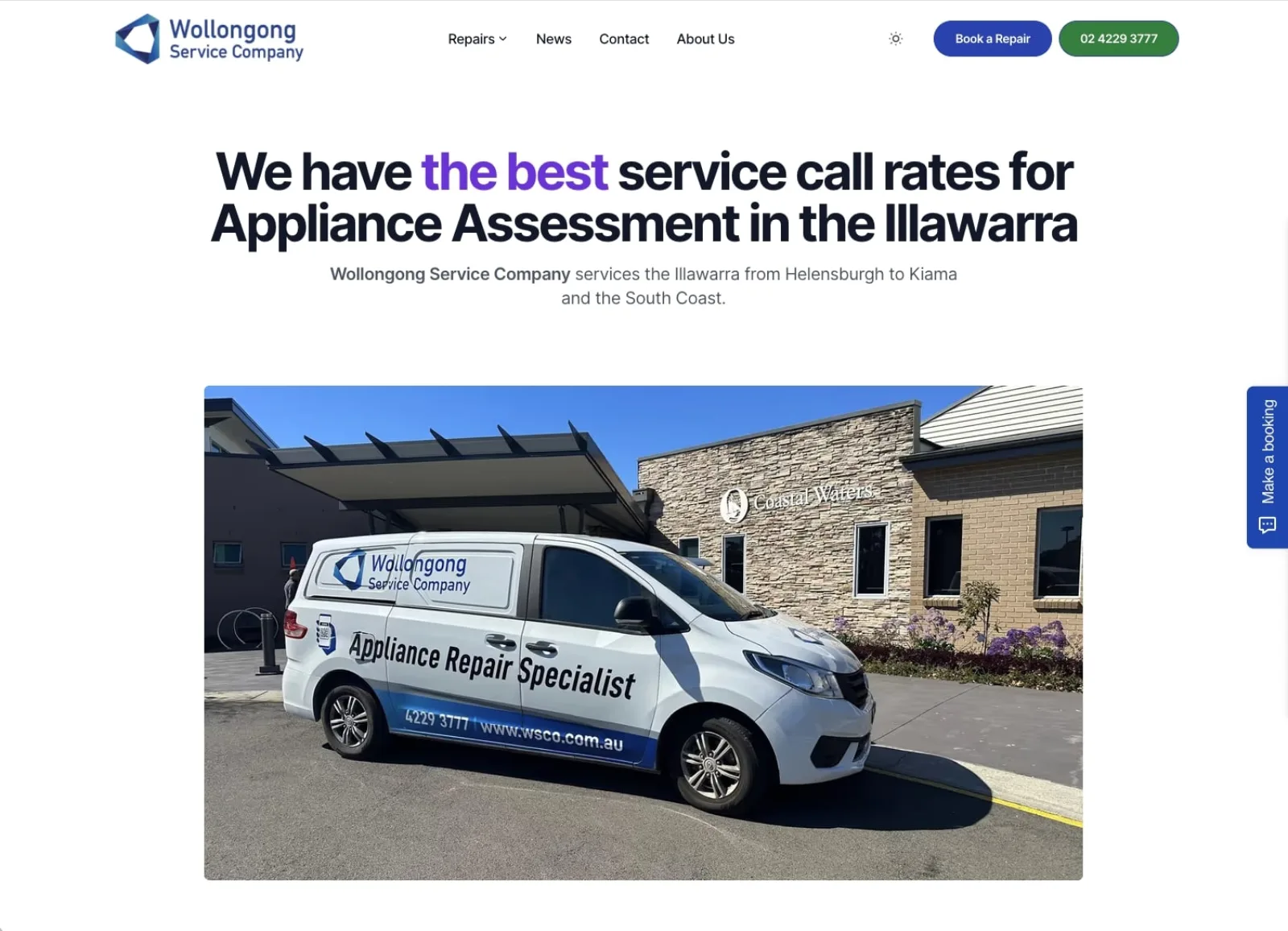
Wollongong Service Company
~200Enquiries a month
An Illawarra appliance repair business with a 20 year reputation now gets about 200 enquiries a month from a tradie website built for phones and local search.
Your questions
Do I have to be registered to be an NDIS provider?
How many NDIS providers are there?
Can I say my service is NDIS approved?
Can I put NDIS in my business name or domain, or use the logo?
What is changing for providers in 2026 and 2027?
How do families and support coordinators find providers?
Can I use participant testimonials?
What should an NDIS provider's website show?
Our services for NDIS providers
A website for your NDIS practice, built and run for you.
$298 a month AUD, no upfront build fee.