Google Ads for NDIS providers, written to pass the NDIA's rules
Ad copy is advertising under the Australian Consumer Law. The wording that wins clicks in other fields can be a breach here.
- $549 a month
- Google Ads for NDIS providers, AUD, GST inclusive
- Month to month
- Added to the $298 website plan, cancel on 30 days notice
- Your account
- You pay Google your ad spend directly, and we never hold your card
Ad copy is advertising
The NDIA's enforcement note of 4 December 2025 reported 604 referrals to the ACCC and 112 to the Commission since August 2024. Most of the wording it named is the wording ad copy reaches for: approved, permitted, fully funded. The copy we write for NDIS providers states the service, the place and the next step, and checks each line against the NDIA's list before it goes into the account.
Headlines name what you do and where. A registered provider can say so, and we confirm the register entry first. An unregistered provider says what it does and for whom. No ad claims outcomes, because the Commission bars efficacy claims that cannot be independently substantiated.
Targeting that Google allows
Google's health in personalised advertising policy limits what audiences an advertiser can build in sensitive interest categories. The practical result is that remarketing lists, customer match and lookalikes are not available there. Location targeting, in-market and custom segments are. We plan for no remarketing, and we flag it as an open question for any non-clinical service, because we do not know how Google classes it.
That makes search the core of the account. People who type a service and a place, or a term such as support coordinator near me, are already in the market, and the ad is shown for the query.
Terms that need care
SDA and SIL attract noise. The first is also a church and a school programme, the second a Mauritian business name, a chemical firm and several kinds of silk. We use the full words in phrase match, and a negative list that grows from the search terms report each week. Job searches get their own campaign, with its own landing page and conversion.
What we measure
Phone taps and calls are tracked as separate conversions from form submissions, because Google's own call assets can inflate numbers if left unchecked. We count an enquiry only when a person reaches you. For referral-led segments such as behaviour support or support coordination, paid search is small and we say so. For community access, allied health and recruitment it is the main use.
Budget logic
Families compare two to four providers over weeks, and many arrive through a coordinator. An account judged on seven days will look bad. We set a monthly cap you can hold for a quarter, report cost per enquiry and ask what happened to each lead. We make no promise about volume or cost, and Keyword Planner data for the cost per click comes later.
See the web design and SEO pages for the other two parts.
Wording and audience limits on the ads
NDIA, the ACCC and Google Ads policy
The NDIA says businesses promoting offerings as NDIS approved, NDIS permitted or 100% NDIS funded are likely breaching the Australian Consumer Law. It bars stating or implying that goods or services are covered by the NDIS in all cases or that funding is guaranteed. Google's health in personalised advertising policy treats personal health content as a sensitive interest category. Advertiser-curated audiences such as remarketing lists, customer match and lookalikes are not supported for sensitive interest categories, while location targeting, in-market, affinity and custom segments are.
Ad text never says approved or funded in full, and says registered provider only with a register entry. Plan for no remarketing. Google decides whether a given campaign counts as sensitive, and we do not know how it classes non-clinical services such as cleaning or transport.
Read Google's health in personalised advertising policyMatch types and negatives
Observed in Google autocomplete for Australia on 3 November 2026. Volumes and costs per click come later from Keyword Planner.
Target, phrase match
- "supported independent living" {city}
- "specialist disability accommodation" {city}
Target
- support coordinator near me
Exclude from client campaigns
- ndis jobs, ndis support worker jobs
- how to become an ndis provider
Exclude, navigational
- ndis portal, ndis provider login
Exclude, Seventh-day Adventist
- sda sabbath school, sda church, sda homeschool
Exclude, SIL noise
- sil mauritius, sil chemicals, silk
Set people in the area, not interested in it
Regional
Location settings use presence, meaning people in the location, so interstate searchers do not fill the budget for a visit-based service. This is general Ads practice, not an NDIS rule.
- Exclude areas outside your delivery footprint
- Use state or metro region for SIL, suburb radius for clinics
- Keep client campaigns and recruitment campaigns separate
- Count calls and form sends as separate conversions
What an ad click turns into
Most paid traffic here is the family in search of a service. Referral traffic mostly bypasses the ad.
- Phone call from a family
- Same day
- A call extension, hours that match when the phone is answered and a landing page with the number at the top.
- Short enquiry form
- Same week
- Name, phone or email, and a comment. Track each submission as a conversion.
- Worker application
- Same week
- A separate campaign, landing page and conversion, so cost per client is not blurred.
- Vacancy enquiry
- Weeks
- A page per home with a live status. An ad that sends someone to a full house wastes the click.
Ads work in related fields
We have no NDIS clients. The first card is a service business whose Google Ads we run and the second a regulated practice. Their results are their own.
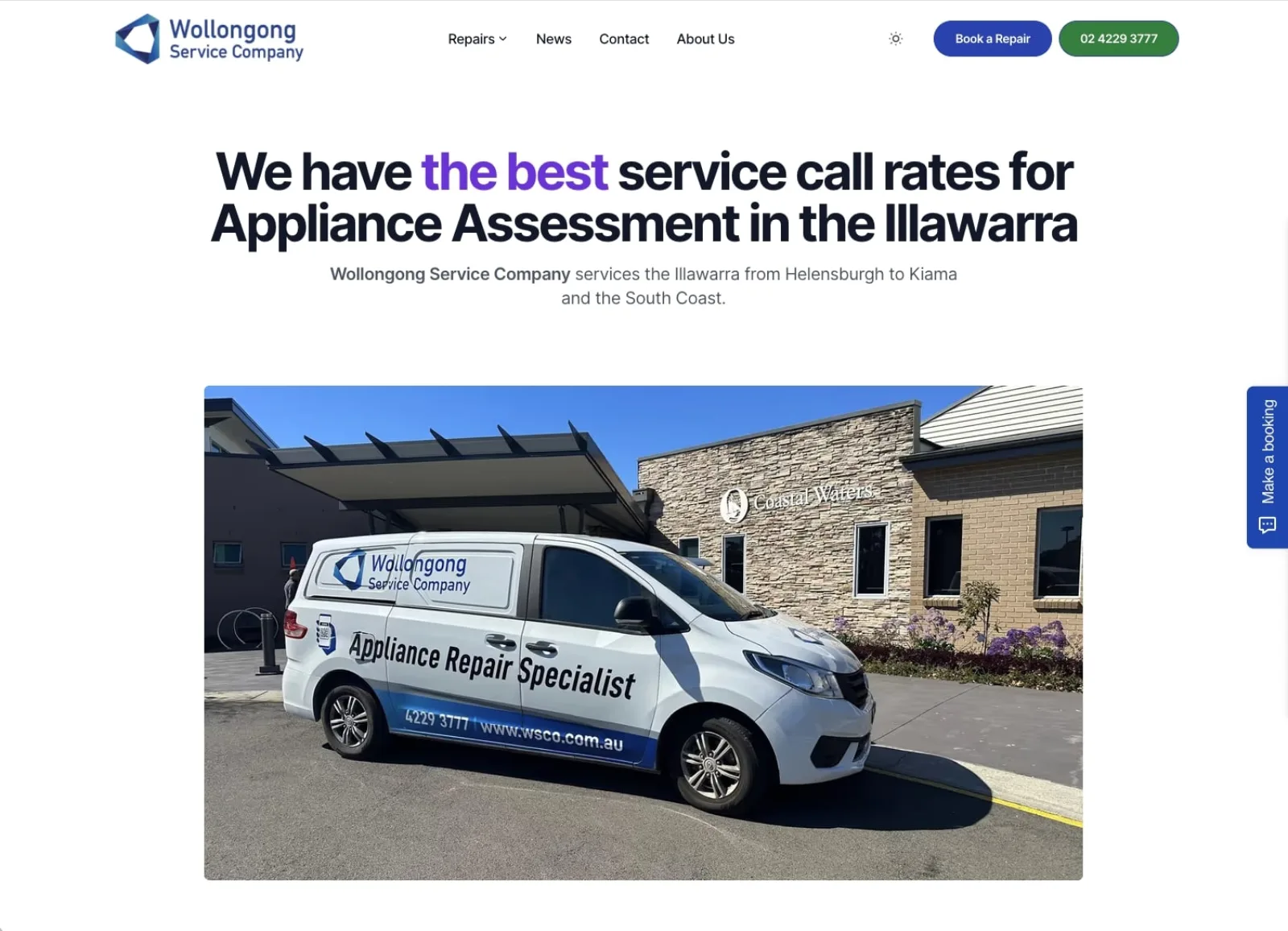
Wollongong Service Company
~200Enquiries a month
An Illawarra appliance repair business with a 20 year reputation now gets about 200 enquiries a month from a tradie website built for phones and local search.

Karnib and Co
Page 1For criminal lawyer searches in Wollongong and Liverpool
We built, migrated and host the law firm website for a criminal law practice in Wollongong and Liverpool, and it now ranks on the first page of Google for criminal lawyer searches in both cities.
Google Ads for NDIS providers: your questions
Can the ad say we are an NDIS approved provider?
Can we run remarketing to people who visited our site?
Why do we need exact control of SDA and SIL terms?
Should we advertise to would-be providers?
How should we budget a service people take weeks to choose?
Can we pay a platform to list us?
Can a discount offer go in the ad?
Do you set the ads to run all hours?
Google Ads for NDIS providers, month to month.
$549 a month AUD, on top of the $298 website plan.