Web design for NDIS providers, built to match the register
Coordinators and families check a provider's site against what the regulators say it may claim. We build the site to pass that check.
- $298 a month
- Website for NDIS providers, AUD, GST inclusive
- No build fee
- We carry the cost of the build and recover it through the monthly fee over a 12 month term
- Live in 48 hours
- Hosting on Cloudflare, SSL and security upkeep
The site is read against the register
NDIS Quality and Safeguards Commission and the NDIA
You may advertise as a registered provider only if you are registered. The NDIA says not to suggest an affiliation with the NDIA or NDIS where none exists, and lists NDIS in business names, trading names and domain names as an example of a misleading statement. It also bars the words NDIS approved and 100% NDIS funded. The NDIS logo needs written consent.
Registration groups are shown as the Commission lists them, with a link to your register entry. An unregistered provider says so and states who it works with. We do not use NDIS in a domain, a site name or a logo, and we do not use the logo without consent.
Read the NDIA logo guidelinesWho the site has to serve
A provider site is used by people at very different points. The home page cannot answer all of them, so it points each to a short route.
- Family or participant
- Weeks
- Plain description of what you deliver, where, and for whom. A phone number with staffed hours and a short form.
- Coordinator or local area coordinator
- Often urgent
- A referral page with a named contact, funding types accepted and current capacity.
- Plan manager or self-manager
- Routine
- How you invoice, your price position against the NDIA schedule and a contact for billing questions.
- Job seeker
- Same week
- A careers path that is separate from the client pages.
- Regulator or auditor
- On review
- Registration groups, policies, a complaints route and named key personnel.
What the site is for
An NDIS provider site has to be believed. A coordinator opens it after someone has recommended you, and checks whether you are on the register, whether the services listed match your registration groups, and whether the site makes promises the NDIA says nobody may make. A family opens it and wants to know, in a minute, whether you cover their suburb and how to speak to a person.
We build the first screen around those two readers. It shows what you do, where, and how to ring or send a short enquiry. The registration block sits beside it.
The registration block
Registered providers get a block that lists the registration groups held, the audit status and a link to the register entry. We build it once and reuse it on every page that mentions a service. The Commission lists about 27,000 approved providers, so the block is how a visitor tells yours from the rest.
Unregistered providers are a large part of the market. A site for one says what that means: you work with participants who self-manage or plan-manage, and you follow the NDIS Code of Conduct and worker screening requirements. It does not say official, approved or registered.
Pages by segment
The page set depends on what you deliver. Support worker agencies get programme and careers pages. Supported independent living and SDA providers get a page per home. Allied health practices get clinician and referral pages. Behaviour support, plan management and support coordination sites are short and built around referral and trust. The hub page for each segment sets out the details, starting at the NDIS providers hub.
Referral routes
Every provider site that takes referrals needs a route for the referrer. That is a page with a named intake contact, the funding types accepted, current capacity and a short form. We keep capacity as an editable line that a person at the provider owns, because a wrong number costs more trust than none.
Plain language and accessibility
We build to WCAG 2.2 AA, with real text, strong contrast and keyboard-friendly forms. Easy Read versions of the main pages are available as an extension. These are not decoration. They are the site working for the people you support.
What we leave out
We leave out claims of approval, guaranteed funding and outcomes. We do not collect NDIS numbers or diagnoses in forms. We do not put NDIS in the domain, and we say so before we start, because it affects the name you pick.
Say where you actually deliver
Regional
Pages tied to places make sense only where you have workers, houses or a clinic there. Templated city pages are the common weakness in this market.
- A service area page per region you roster
- A page per house or clinic where the place is the service
- Hours, phone and address that match your Business Profile
- No page for a suburb you do not serve
Sites we have built in related fields
We have no NDIS clients. These are a regulated law practice and a phone-and-form service business we build for. Their results belong to them.

Karnib and Co
Page 1For criminal lawyer searches in Wollongong and Liverpool
We built, migrated and host the law firm website for a criminal law practice in Wollongong and Liverpool, and it now ranks on the first page of Google for criminal lawyer searches in both cities.
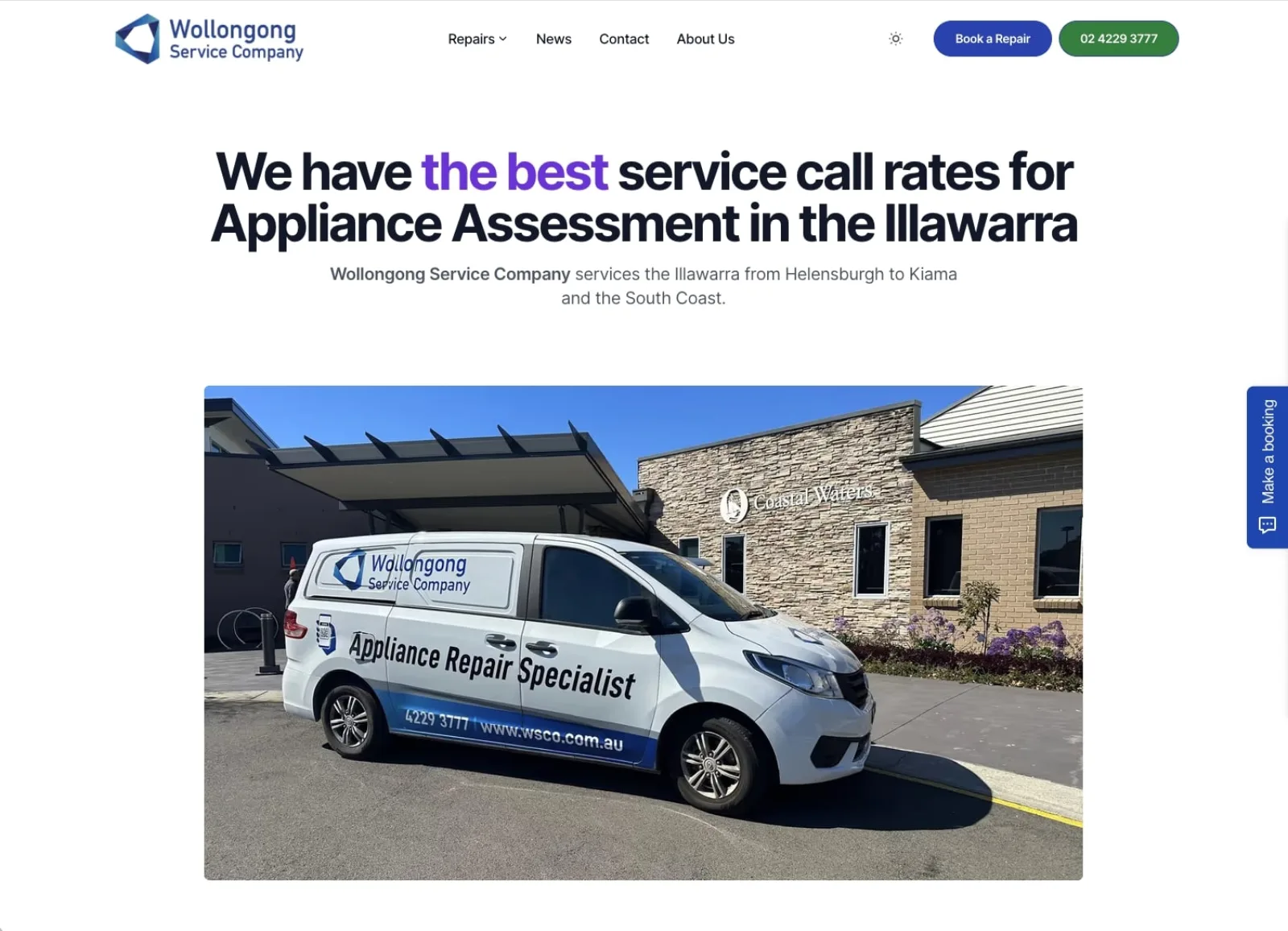
Wollongong Service Company
~200Enquiries a month
An Illawarra appliance repair business with a 20 year reputation now gets about 200 enquiries a month from a tradie website built for phones and local search.
Web design for NDIS providers: your questions
How many pages does an NDIS provider site need?
What does the enquiry form ask?
How accessible does the site need to be?
Should we have Easy Read pages?
Can the site show participant stories?
Can we use the NDIS logo?
Do we need a separate site for recruitment?
How does the site handle the 2026 changes?
A website for NDIS providers, built and run for you.
$298 a month AUD, no upfront build fee.